I am totally understanding the need to be careful in our language
with prospects, and even the general public. I do not agree with lying
about our intentions to evangelize, or deception to gain access to "closed areas".
However, I can see the wisdom of prudent language when living or
ministering in a hostile land.
Recently I was asked to teach a seminar to converted Muslims. I was instructed to not call Jesus the "Son of God" or to mention "Trinity". Furthermore I was told to call God "Allah" and use "Al Masheia" rather than "Jesus".
When we are dealing with converted Muslims I think it would be irresponsible
not to teach the whole counsel of Scripture and introduce our new brothers
to good theology. I know that Muslims have a problem with calling Jesus
the Son of God because they know it means that He is literally God's Son
and therefore divine. But, that is the point.
Some years ago I had a bad experience with the IMB's "expert" on Muslim
evangelization. He said that Muslim, Jews and Christians all worship the
same god. I asked, "But, doesn't Jesus say, 'I am the Way, the Truth and
the Life... no man comes to the Father except by me.'"? The teacher
rebuked me and said that I was only interested in arguing semantics. I
responded that I was not speaking of semantics at all, but the very words
of God. He had said that Jews and Muslims worship the God I worship, but they do not
know Jesus. SO, in what way can they come to the Father? How can they
worship a God that can only be approached through Christ Jesus? It was an argument over words, primarily the Word of God.
Recently I had a conversation with a Jehovah's Witness. In the past they
would have never said, "Jesus is LORD." However, they have recently
started saying, "Jesus is lord." Notice the difference? "LORD" =
God, Jehovah, the Word incarnate. "lord" = master, landowner, knight. When I
say "LORD" I proclaim that Jesus is God. When a JW says "lord" he is
saying "mister." Very subtle, and very dangerous. So it isn't just words I am
concerned about it is their meaning.
Allah is an Arabic word for the god of Mohammed. After thinking about it I might could use the term "allah" to refer to God, but not Allah. I think I would be compelled to clarify each time I said allah "notice the small 'a'." Or maybe "allah - I mean the triune God of the Universe". It would be difficult, but I think I could find some way to accommodate on this point.
Many languages have a word for god and another for God. I have heard Muslims in America use "God" when speaking of Allah.
Really this whole issue for me is resolved in the Trinity. The Nicene and
Apostle's creeds predate Islam by several hundred years, and I would think
that a converted Muslim would readily agree with these historically
orthodox statements. In fact, for several hundred years you would not be
considered Christian, nor be baptized if you did not profess a Trinitarian
creed. Christ's divinity is almost impossible to discuss without a
discussion of the Trinity.
If former Muslims had sound teaching in this area I think it
would give them a foundation that would be unshakable. Someone recently implied that the Trinity is too advanced for new believers, but I
would argue that a child could understand - indeed we must have the faith
of a child to enter into the Kingdom of Heaven. Maybe they would not be
able to explain, but I am confident that the Spirit (if indeed they have
the Spirit of Christ) would bear witness and they would shout "glory to
God" as the beauty of God's triune nature is proclaimed to them.
Often we make the mistake of not communicating deeper truth with new
converts. Somehow we think that a lack of formal education might mean
that they are too ignorant to grasp complex concepts. We think that
evangelism is too important to waste time on theology. However, we see
many examples in Scripture of men preparing for years (some for decades)
learning about God before serving Him.
Stephen Kennedy, Mission Coordinator for IOI, had a beautiful experience with a new evangelist. He came from the countryside and was very poorly educated. When he was joining IOI he had to sign a form that states that he agrees with the Apostle's
Creed. He did not know what it was, so Stephen read it to him. When he
heard what the creed contained he began to say, "Yes! Yes! Praise God!"
It was wonderful to see that the truth of this creed was readily accepted
by this dear brother. He was encouraged to find that this creed predated
his personal experience by over 1,700 years.
To contrast I heard a song tonight on Christian radio. The lyrics said
something like, "It isn't important that I understand some creed, or even
what I believe... I want to feel like I am falling in love." So, are we
saying that it does not really matter what we believe about God as long as
it feels right? Call Him Allah, or Baal, or Bob - Trinity, not trinity -
Jesus, Mohammed, Buddha - don't all roads lead to the same destination? -
words don't matter as long as it feels right, promotes peace and we keep
the numbers coming.
I cannot state emphatically enough how central the Trinity is to everything I might teach. I mean my name is PATRICK (as in Saint Patrick the Trinitarian theologian that won Ireland for Christ - and to this day symbols for the Trinity are plastered
everywhere in Ireland including on beer bottles) for goodness sakes!
Showing posts with label Catholic. Show all posts
Showing posts with label Catholic. Show all posts
17 August 2010


14 April 2008
The Word of God

Many in the States would say that the Bible is the Word of God. Just one example of this belief about the Bible comes from a website of a Baptist fellowship.
"1. By "The Holy Bible" we mean that collection of sixty-six books, from Genesis to Revelation, which, as originally written does not only contain and convey the Word of God, but IS the very Word of God."
This organization is not alone in a statement like this -- it is very common among independent and fundamental Christians in America. In essence what they have accidental done with their words is to elevate the Bible to Deity - "The Bible IS the very Word of God."
One site I found (I believe it was God Tube.com) says, "The Bible is the living Word of God."
Now to be fair I do not believe that they actually mean what they say. I think what they are trying to say is that the Bible is more than a book, it is a perfect revelation of God to man in written form, and faithful for doctrine, etc. The scriptures are relevant to our lives today and God speaks through the pages into our lives. In other words they aren't liberals. The problem is that is not what they say exactly.
It is not only a belief among Baptist, but this belief can also be found among denominations such as the conservative Presbyterians. One Presbyterian pastor actual told me that the Bible is the Perfect which was to be revealed, and after its' coming would do away with knowledge, tongues, etc. Again, in essence this minister was saying (although I don't believe he means it this way) that the Bible is the second coming of Jesus. The Bible is the Word (God) incarnate (in flesh).
Now I want to be very clear that I do believe the Bible is the written record of God's words to us. The Bible is useful for doctrine, and all our beliefs and practice should be weighed against the whole counsel of scripture. However, Jesus is the Word of God that is revealed in the Bible. Jesus is the Sword of God that divides bone from marrow, and judges the hearts of man!
To say that the Bible IS the Word of God is like saying that the badge IS the policeman. Certainly the badge reveals to us that the person holding it is a policeman. The badge may tell us where the policeman comes from. It may tell us the limits of his authority (ie. federal or local). There are certain things implied for one who holds a badge, and certain things expected. The badge bears a certain amount of authority (a symbol that actually does/bears something). But, the badge is not the living policeman, nor is the badge the authority that it represents. The badge is only a symbol that communicates a great reality.
What fundamentalists are trying to do is to say that they believe the Bible is the final authority on every subject. They want you to know that they believe the Bible from "Genesis to Maps". They want you to know that they are REAL Christians. They want to convey that they try to live a holy life and obey the commands of God. They want you to know that they do not believe that God is still revealing information about Himself. Most of all they want you to know that they are not charismatic pentecostal and that there is not going to be any new prophets who make new revelations about God or His plan for mankind.
The problem is that most fundamentalist know very little of the Bible. There are many good Baptists who have memorized a plethora of proof texts and can argue them against the barrage of the best trained Jehovah's Witness proof texts. But, when it comes to a good understanding of the whole counsel of Scripture, or finding Christ revealed in the Old Testament, or even an elementary understanding of Church history the average fundamental evangelical Christian will have as poor an understanding of these things as the average Christian cultist.
An example of this poor understanding would be the belief that Jews are blessed and Arabs are cursed. This is a strong belief among fundamental evangelicals in America, and it is not found in Scripture. In fact the we find that God blessed Ishmael. We also see throughout the New Testament that "all of Israel is not Israel", and that Paul even desired the salvation of his fellow Jews so much that he was willing to die in their place -- however, it is "by faith that we (or anyone Jew or Gentile) are saved."
This same phenomenon is happening to the Gospel. Some ministers say that "it is all about the Gospel." In some sermons you might hear the word "Gospel" a dozen times, but you never actually hear the Gospel -- the death, burial and bodily Resurrection of the incarnate Word of God. In deed if you ask the average evangelical the question, "What is the Gospel?" You will get a strange variety of answers that includes, "The Bible. The Good News. It has to do with Jesus." Now, when you point them to I Corinthians 15:1-5 they will say, "Yeah, right the death, burial and Resurrection of Jesus."
If you watch much Christian television in America you will hear a lot about money, how to have a successful life, how God wants to bless you, the Crucifixion, the Gospel (although few explain what they are talking about with that phrase) and our need to pray the Sinner's Prayer. What you will not hear much of is public reading of Scripture (I don't think I have ever heard an entire chapter read on Christian radio or TV, much less an entire book of Scripture).
I believe we are perishing for lack of knowledge. Although we firmly believe the Bible is the word of God, we don't know it. Although we believe the Gospel, we cannot articulate it. Although we believe the worship of God is our most important duty, we cannot really tell you what it means to worship God. We have protested the Catholic system and all her creeds, only to replace them with inferior copies. At least the Nicene Creed does not elevate the Bible to being the fourth person of the Trinity, and the ancient creeds speak more of hope of the bodily Resurrection than some kind of secret evaporation of the faithful. There is no doubt that the Church in America is already left behind, we have exchanged our inheritance for a bowl of porridge. Rather than using the Bible to know about God we have practically elevated it to a god, and use it to divide and conquer.
Jesus says, "If any will come after me let them take up their cross and follow me." "You must eat my body and drink my blood."
In America we come to a table of empty calories - cute sayings, proof texts, guilt, prosperity, "Jesus will fix all your problems." No wonder so many leave the table hungry!
This is only partly the reason for why you see so many young people in America who are hungry for the ancient things of our faith. The modern methods depend of theological maxims and meeting of perceived needs. All the while what we desire is to know and be known by God. We desire the Man of salvation, not the plan of salvation. We want to see and know that He is God. Truly it is by hearing that we receive faith, but we must hear Christ not just proof texts. The Bible reveals Christ, and to quote a common phrase among fundamentalists, "It (salvation) is a relationship." As we hear about Christ revealed in Scripture and walk with Him in the community of His Bride (the Church) we should be moved to obedience to Him. If He is God then what does that mean to me, and how should I then live?
It was in the secret meetings in homes, the reading of books of Scripture, the breaking of bread and the giving of life that the early Church was formed and conformed to the image of Christ. It was their life and death together. It is the same today -- we long to be in community, we want to know Christ now in flesh and blood. We long to worship God in spirit and truth, not simply meet once a week for a presentation of a "worship experience." The ancient traditions involve our bodies - we sing, we pray, we stand, we listen, we smell, we eat, we drink, we kneel, we bow, we hold out our hands, we repeat, and then we go back out into the world and live a life of worship.
13 February 2007
Quote of the Weak - God's Word

"It was as if a gentle southerly wind were blowing. It was as if the Sun of righteousness were shining close by, causing sweet smelling spiritual spices to flow. Yes, and now may God send forth His Word and may it make them flow in us."
- Bernard of Clairvaux (1090-1153)
Saint Bernard of Clairvaux Frenchman Who Established the Monastery at Clairvaux (Art.com)
30 January 2007
The Word of God
 He That is of God Hears God's Words
by James Tissot (Art.com)
Never one to shy away from controversy -- my question today is what (or who) is the Word of God?
My brothers at the largest Baptist church in Memphis have erected a 20' statue of the Bible in the foyer of the church. These same brothers would rightly proclaim that a statue of Mary in the church at Fatima, Portugal is an idol. However, just like the faithful Portuguese Catholic that erected the statue of Mary they too are blind to the fact that they have made an idol of the Bible. It is Bibliolotry.
Growing up Baptist I was taught that the Bible is the Word of God. Many proof texts support this claim (and for regular readers of the Bishop's Beard you know how I loath proof texts). However, a reading of many of these proof texts in their context prove that this proclamation is not correct. Hebrews 4:12 was a memory verse in VBS (Vacation Bible School) and a favorite verse to find at Bible "Sword" Drills. "For the word of God is quick, and powerful, and sharper than any two edge sword, piercing even to the dividing asunder of soul and spirit, and of joints and marrow, as is a discerner of the thoughts and intents of the heart." Sounds like the Bible is a powerful sword, unless you read this same verse in its context and see that the entire passage is about Christ, not the Bible. Because Jesus is the Word of God He is also the Great High Priest that discerns the thoughts and intents of the heart. Romans 8 proclaims that the Spirit of God is the One who searches hearts and makes intercession for us.
After preaching at a Presbyterian church I was gently rebuked for preaching the hope of seeing Christ "face to face" as though it was a future event. I had made reference to I Corinthians 13 where our hope of Resurrection ("...when that which is perfect has come...") is hope for a physical event where we will know Christ as intimately as He now knows us. I was told that the "Perfect" in this passage is the Bible, which has already come so that we can know Christ through His word. Knowledge, tongues and prophesy have all been done away with because we now have the Bible. The problem that I have with this interpretation (other than the fact that it is wrong) is that the Bible does not contain every word of Christ (John 21:25), and I don't know how many hairs He has on His head, much less can I see His face or look into His eyes. The Christian hope is that we will be physically resurrected and we will know God like He knows us.
I understand what the fundamentalist is trying to do when he says that the Bible is the word of God and the final authority for life and faith. He is trying to distance himself from the charismatic chaos of modern times and the "Christian" cults who have extra Biblical "scripture" and anti-Christ "revelation". The problem is that interpretation of Scripture can vary greatly, so how then is the Bible the "Final Authority?"
I am always looking for balance. I think the balance in this issue is simply that we must look to the whole counsel of Scripture, which contains the written revelation of the Word of God, for instruction in life and faith. Certainly the Bible is the bench mark by which all revelation, prophesy and tongues should be judged. The Bible is a way to know about God. The Apostles gave us timeless instruction in how we should live. The prophets foretold Christ, and Christ revealed the Father to us. Ultimately it is by faith that we know Him, and His Spirit lives within us aiding us as we struggle to know, understand and comprehend the depth, width and height of His love.
There is no doubt that the Bible contains the words of God. But, Jesus IS the Word of God.
12 December 2006
What Americans believe about God
By Jennifer Harper
THE WASHINGTON TIMES
Published November 12, 2006
The vast majority of Americans believe in God. But in the land of the free, ideas about the more personal nature of God can be subject to some interpretation. (In this survey traditional Protestants have been distinguished from Evangelical "Born-Again" Christians).
Only 1 percent of Americans overall, for example, think God is female, according to a wide-ranging Harris poll of 2,010 adults. Among men, Protestant and Born-Again Christian respondents, the number was 0 percent; among women and Catholics it was 1 percent; among Jews, 7 percent.
More than a third -- 36 percent -- said God was male. More women than men thought God was male, 39 percent to 34 percent, respectively (interesting that more American women than men consider Biblical language such as "Father" accurate). More than half of Born-Again Christians agreed, along with about 47 percent of the Protestants and Catholics. Other responses were mixed. Overall, 37 percent said God was neither male nor female. Ten percent said God was both male and female, while 17 percent were not entirely sure what they believed.
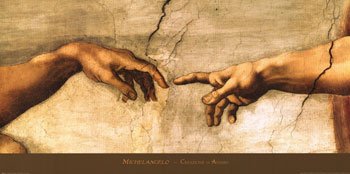
Does God look like Michelangelo's vision on the ceiling of the Sistine Chapel? Maybe. The survey showed that 9 percent said God appeared "like a human with a face, body, arms, legs, eyes," though the percentage was slightly higher -- 13 percent -- among Protestants, but just 1 percent among Jews.
More people -- 41 percent-- were comfortable with the idea that God is a "spirit or power that can take on human form, but is not inherently human." The sentiment was highest among Born-Again Christians, with 60 percent agreeing with the statement (What happened to the doctrine - Fully God and Fully Man?). More than a quarter of Americans overall say God is "a spirit or power that does not take human form," a belief shared by 49 percent of Jewish respondents.
Beliefs about God's involvement in events on Earth also varies. Twenty-seven percent of Catholics said God "controls what happens on Earth," compared with 41 percent among Protestants and 57 percent among Born-Agains. Forty-four percent said God "observes but does not control" what happens here. That figure rises to 58 percent among Catholics, but falls to 37 percent among Born-Agains.
A slim majority of Americans -- 51 percent -- believe Christians, Jews and Muslims "worship the same God," the poll found. That idea is shared by 63 percent of Catholics, about 48 percent of Protestants and Jews and 34 percent of Born-Agains. Almost a third overall said the three faiths do not worship the same God, and 16 percent were unsure. (Jesus said about Himself, "I am the Way, the Truth and the Life. No man comes to the Father except through me." John 14:6)
Intensity of belief also varies among faiths and political parties. Overall, 73 percent of Americans believe in God; the numbers are 97 percent among Born-Agains, 90 percent among Protestants, 84 percent among Catholics, 64 percent among Jews, 83 percent among Republicans and 72 percent among Democrats.
Are Americans "absolutely certain" there is a God? Born-Agains are the most adamant, with 93 percent agreeing with the statement (and how did that 7% become "born-again" and not believe in God???), followed by 76 percent of Protestants, 64 percent of Catholics and 30 percent of Jews. Overall, 6 percent are "absolutely certain" there is no God.
Almost half of Americans overall -- 46 percent -- attend church a few times a year, 35 percent go once a month and a quarter go every week or more often.
The survey was conducted Oct. 4-10 and has a margin of error of two percentage points.
Creation of Adam (Detail) Michelangelo - Art.com
20 September 2006
What did the Pope say?
 The Pope's recent speech concerning peace and dialogue was the fuel for violence and threats from the Islamic world.
His words, a quote taken out of context, were an accusation that Mohammed taught growth by the sword and this teaching is wrong. Today the Pope said that this was not his view. Yet, the Muslim reaction around the world has served only to prove that Islam is a violent religion.
If you do read the Pope's speech it is a bit disturbing to see that the Pope seems to refers to the Koran in terms of scripture. If anything the Pope has been too benevolent by making Islam on the same plain as Christianity. Moderate Islamist have tried to calm their Fundamentalist brothers by pointing out that the Pope promotes Islam as one of the three great monotheistic religions, and that "thinking" Muslims are in some way in tune with God. Many say that the Pope is only speaking out against "radical" Islamist that have "hijacked Islam."
The belief in the equality of belief (at least as far as the "monotheistic" religions) is popular among many Christians these days, but you will find it is rare in the Islamic world.
One point that the Pope was trying to make is that you cannot force religion on anyone. Sure the Catholic Church has been guilty of trying, and various Christians throughout the history of the Church have tried coercions in many forms. But, listen to what the man is saying! He does not believe in forcing religion on people - either the Christian or Muslim religion.
All religions are not equal. To say that "Mohammed promoted peace" is about as smart as saying that "Jesus promoted violence".
Jews do not believe that God is triune. Muslims do not believe that God is triune. More than philosophy Christianity stands out above the other "monotheistic" religions pointing to Jesus as the Way, the Truth and the Life -- the only way to get to the Father. Christianity is not only monotheistic, but it is Trinitarian.
While I do not think that the Pope is God's voice on Earth it does trouble me to hear him apologize for the reaction that misinformed zealots (which seem to be the majority) had concerning his quote. Pope Benedict, please do not make apologies. Preach the Gospel, repentance and faith, and Christ as the only way!
23 July 2006
Quote of the Weak -- Indulgences
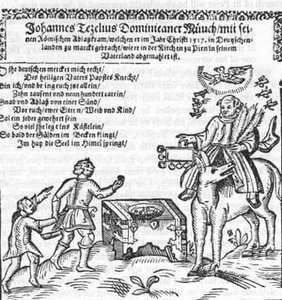 A German illustration of a priest collecting "indulgences" on behalf of the Catholic church. An indulgence could be purchased that would bring a blessing or "guarentee salvation" of one's soul. This was just one of the issues that sparked the Protestant Reformation. The last line of the poem reads, "As soon as the coin in the coffer rings, / The soul at once into Heaven springs."
"After 1500 years you could purchase blessings from Rome. But don't be too hard on the Catholic church. Protestants have only been around for 500 years and we have TBN."
--Ross

20 July 2006
A cup of Christ?
 Icons have been used through much of Christian history to convey certain truths of Scripture. Some Icons are obviously heretical (ie. a depiction of the Trinty with three "Jesus" heads), while others may be helpful. This icon is meant to convey the "true presence of Christ" in the Eucharist.
I don't think this was what Jesus had in mind when He said , "this is my blood." Yet, it does give pause for thought.
29 June 2006
You can judge a cover by the book.
You can find out a lot about people by the books they recommend, not necessarily the books on their shelves.
I admit that there is a limit to the knowledge you can gain about someone this way, but in general it is a fair method. A 30-something year old lady who recommends "Love You Forever" must be a mother of small children (or a sentimentalist at the very least). A man who recommends the "Gunowner's Bible" must be a gun owner (and maybe someone you should never insult). A pastor who has copies of Spurgeon and the Church Fathers may have read neither; instead ask him what he recommends if you really want to know where he is coming from.
I finally updated and repaired the links to my book recommendations on the IOI website Resources and Links. My wife observed that I am definitely "all over the map." It was not the subjects that seemed disconnected as I recommended books about discipleship, missions, ministry, travel (particularly Ethiopia) and theology. It was the variety of authors that seems a bit, how shall I say it -- ecumenical. Baptist, Lutheran, Catholic, Presbyterian, Evangelical Free and Puritan books are among those recommended. Some might think it strange to recommend Barth, Chesterton and Edwards on the same page, but what I am looking for is the gold that each man mined rather than fitting into a particular camp. We are, after all, the Body of Christ and there are many members each with particular gifts and needs.
I love to tell people that I go to Christ Community Church, and then have them ask me what denomination we are. What they want is a label so they can understand where I am coming from. So, instead of saying we are "non-denominational" (which is a label with its own definition), I say, "We are a missions-minded community of people that are trying hard to love God and each other that grew from a former Methodist Bible church that is elder led and similar to Anglican Catholicism in liturgy with a reformed Baptist theology (that depends more on the Church Fathers than the reformers), charismatic worship and an Irish pub band that sings ancient hymns along with modern praise songs." But I guess you could have figured that out by looking at my book recommendations.
I admit that there is a limit to the knowledge you can gain about someone this way, but in general it is a fair method. A 30-something year old lady who recommends "Love You Forever" must be a mother of small children (or a sentimentalist at the very least). A man who recommends the "Gunowner's Bible" must be a gun owner (and maybe someone you should never insult). A pastor who has copies of Spurgeon and the Church Fathers may have read neither; instead ask him what he recommends if you really want to know where he is coming from.
I finally updated and repaired the links to my book recommendations on the IOI website Resources and Links. My wife observed that I am definitely "all over the map." It was not the subjects that seemed disconnected as I recommended books about discipleship, missions, ministry, travel (particularly Ethiopia) and theology. It was the variety of authors that seems a bit, how shall I say it -- ecumenical. Baptist, Lutheran, Catholic, Presbyterian, Evangelical Free and Puritan books are among those recommended. Some might think it strange to recommend Barth, Chesterton and Edwards on the same page, but what I am looking for is the gold that each man mined rather than fitting into a particular camp. We are, after all, the Body of Christ and there are many members each with particular gifts and needs.
I love to tell people that I go to Christ Community Church, and then have them ask me what denomination we are. What they want is a label so they can understand where I am coming from. So, instead of saying we are "non-denominational" (which is a label with its own definition), I say, "We are a missions-minded community of people that are trying hard to love God and each other that grew from a former Methodist Bible church that is elder led and similar to Anglican Catholicism in liturgy with a reformed Baptist theology (that depends more on the Church Fathers than the reformers), charismatic worship and an Irish pub band that sings ancient hymns along with modern praise songs." But I guess you could have figured that out by looking at my book recommendations.
28 June 2006
Quote of the Weak -- Disagreement
"At one point I had to explain how I differed on a certain point from both Catholics and Fundamentalists: I hope I shall not for this forfeit the goodwill or the prayers of either. Nor do I much fear it." -- C.S. Lewis
"Therefore I take pleasure in infirmities, in reproaches, in needs, in persecutions, in distress, for Christ's sake. For when I am weak, then I am strong." (2 Corinthians 12:21)
"Therefore I take pleasure in infirmities, in reproaches, in needs, in persecutions, in distress, for Christ's sake. For when I am weak, then I am strong." (2 Corinthians 12:21)
24 June 2006
Graffiti in the bell tower
I really should stop swearing oaths. It is an exercise in ungodliness, and besides that I almost always end up breaking my word eventually. Other than my marriage vow and an oath never to eat at Shoney's again, most of my rash vows have been broken.
I climbed the stairs of the bell tower in the cathedral in Cologne a couple of years ago. It was worth the trouble and the 2 euro they charge. After ascending and descending the 500+ stones stairs of the narrow passageway to the historic bells I said, "Well, I'll never do that again." What I should have said was, "I'd rather not do that again."
Two years later I found myself purchasing another 2 euro ticket for the privledge of losing my breath and getting cramps in my legs. My daughter was traveling with me and I thought it would be a crime not to take her to the top of the tower and see the view of the city. It was worth the trouble of course, and I took a picture of her that is one of my favorites.
I had already seen the bells and the view so this time my attention was turned to the graffiti that fills the inner walls of the tower stairway. Lovers, students, pilgrims, Satanists and others had taken their turns memorializing their journey to the cathedral by writing inscriptions with a variety of tools and languages. I was repulsed by the bold vandalism and at the same moment tempted to memorialize our visit. In some way we want to be a part of the greatness of the 700 year old building, and the permenance, faith and hope it represents. Graffiti on top of graffiti had made much of the writing illegible and served to illustrate the nameless mass of people that have come and gone like fading letters over the years.
Patrons of the cathedral are buried in eloquent coffins and tombs littering the main floor of the cathedral. Stained glass windows serve as reminders of great men through the ages. An elderly woman kneels in prayer. A group of Asian tourists snap photos. A priest with a coin box strapped to his chest scolds men who forget to remove their hats as they enter the holy place. Gift shops built into the outer walls peddle scale models of the cathedral, religious books and pornographic post cards. A man dressed in a blue bodysuit and wearing a jester's hat performs for the crowds outside the front door. A three-piece accordion band from the Ukraine plays classical music in the courtyard. A street artist spends his day chalking a picture of Mozart on the sidewalk. McDonald's is just across the narrow street and located next door to a hundreds of years old bier haus. It is both sublime and ridiculous.
It is in this place that I am reminded that our names are written in a place that is eternal. I take a deep breath and for a moment I cease despairing of the vanity of life.
I climbed the stairs of the bell tower in the cathedral in Cologne a couple of years ago. It was worth the trouble and the 2 euro they charge. After ascending and descending the 500+ stones stairs of the narrow passageway to the historic bells I said, "Well, I'll never do that again." What I should have said was, "I'd rather not do that again."
Two years later I found myself purchasing another 2 euro ticket for the privledge of losing my breath and getting cramps in my legs. My daughter was traveling with me and I thought it would be a crime not to take her to the top of the tower and see the view of the city. It was worth the trouble of course, and I took a picture of her that is one of my favorites.
I had already seen the bells and the view so this time my attention was turned to the graffiti that fills the inner walls of the tower stairway. Lovers, students, pilgrims, Satanists and others had taken their turns memorializing their journey to the cathedral by writing inscriptions with a variety of tools and languages. I was repulsed by the bold vandalism and at the same moment tempted to memorialize our visit. In some way we want to be a part of the greatness of the 700 year old building, and the permenance, faith and hope it represents. Graffiti on top of graffiti had made much of the writing illegible and served to illustrate the nameless mass of people that have come and gone like fading letters over the years.
Patrons of the cathedral are buried in eloquent coffins and tombs littering the main floor of the cathedral. Stained glass windows serve as reminders of great men through the ages. An elderly woman kneels in prayer. A group of Asian tourists snap photos. A priest with a coin box strapped to his chest scolds men who forget to remove their hats as they enter the holy place. Gift shops built into the outer walls peddle scale models of the cathedral, religious books and pornographic post cards. A man dressed in a blue bodysuit and wearing a jester's hat performs for the crowds outside the front door. A three-piece accordion band from the Ukraine plays classical music in the courtyard. A street artist spends his day chalking a picture of Mozart on the sidewalk. McDonald's is just across the narrow street and located next door to a hundreds of years old bier haus. It is both sublime and ridiculous.
It is in this place that I am reminded that our names are written in a place that is eternal. I take a deep breath and for a moment I cease despairing of the vanity of life.
Subscribe to:
Posts (Atom)


.jpg)