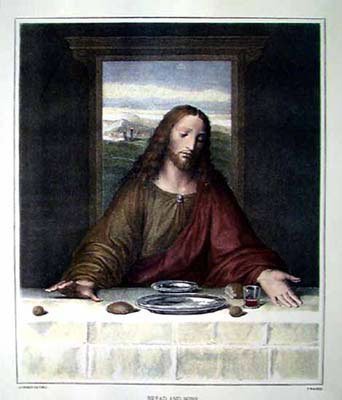
Showing posts with label Sacraments. Show all posts

26 October 2012

Brotherly Love


  I read on article last night that disturbed me greatly.  The article was about a book called "TORN: Rescuing the Gospel from the Gays-vs.-Christians Debate".  The premise of the book is that you can be both a practicing homosexual and a practicing Christian.  In fact the article did help me to understand the exegetical position that seems to reconcile the lifestyles by focusing on Jesus' teaching about love over the commands for sexual purity.

  The author of the book goes into detail about how he realized he born gay.  He was at a Christian concert with a date (female) and he began to be "attracted" to a male he saw there.  He had been battling homosexual tendencies - even trying to date girls.  However, that one event seemed to solidify in his mind that he was indeed gay, and he began a journey to reconcile his Christianity with the desire to have sex with a man.  He goes on in the book to basically dismantle Scriptural teaching about homosexuality by focusing on "committed loving relationship".

  I never cease to be amazed at how people can take a clear teaching from the Bible and proclaim the very opposite using the Bible.  Jehovah's Witnesses, for example, "prove" that Jesus is not God using the very Bible that proclaims Christ's deity.  They simply avoid the many references to Jesus being equal with God and focus on a few verses that seem to back their proposition.  In this case the author of the book takes Romans 1 and "proves" his case that what God desires is committed loving relationships - gay or straight.  So clearly deception, and so clearly he has become one of the ones mentioned in Romans 1:32.

  If you do not believe Jesus is God why would you call yourself a Christian?  If you continue to have gay sex why do you still want to call yourself a committed Christian?

  If we took the example of other sexual perversion and applied the same standards we could justify adultery, bestiality and pedophilia.  It is absurd.

  My experience in Ethiopia has taught me alot about male relationships.  Homosexuality can be found in Ethiopia no doubt.  However, men are free to express physical affection toward each other without it being sexual.  From a very early age boys walk hand in hand and sit with their arms around each other.  We see this same behavior in very masculine situations such as the American football field, but only the most depraved would imply sexual connotations to these situations.

  In the West we are assailed with sexual imagery from birth, and even products such as bacon are sold with "sex appeal".  No wonder our thoughts about perversion and immorality are askew.

   At an early age I felt attraction to certain men.  I was drawn to men who were godly in their behavior.  I was drawn to men who were interested in the things I was interested in.  At the same time I was attracted to the opposite sex, but for wholly different reasons.  Eventually I was attracted to a godly young lady that was interested in many of the things I was interested in - she became my wife.  Many of the men I was attracted to became my mentors.  The godly influences won out over those who only sought to take advantage of me.

  I believe that men are "naturally" attracted to other men, but it is sin that twist this attraction until it developed into perverted sexual desire.  Indeed this is the clear teaching of Romans 1.  People who practice sin (which begins in our thought life) were given over to "uncleanness".  I don't believe young men are born desiring anal sex, I do believe boys are born with a desire for intimacy and relationships.  When this "natural" desire for intimacy is not found in healthy God honoring relationships a counterfeit can be found.

  Many young men that I have counseled who are struggling with same sex attraction began their struggle when their father did not give them the love and affection they desired.  The same is true for many young women who struggle sexually.  Not all who struggle with homosexuality have poor, bad or absent fathers - it just seems to be common.  Many of the ones I have counseled also had an older male who paid them attention and then took advantage of them.  The desire for a father's love and affection was counterfeited by sexual attention.

  Ultimately it is our desire for intimacy with God that is the driving force for many of our relationships in life.  If those relationships are lived out in obedience to Scripture and the commands of Christ we will find that they benefit us spiritually.  A godly marriage is sacramental and aids us in our relationship with God.  A bad marriage can hinder us, and draw our attentions away from God.  A good spiritual brother can sharpen me like iron sharpens iron.  A bad relationship can draw me away and hinder intimacy with God.  Any time we place someone or some desire before God we had become idol worshipers.  We fly in the face of God and proclaim that we know what is best and most fulfilling.

  Men can also have inordinate relationships of a wholly mental sort.  Our desire for intimacy with God can be given over to spiritual masters and gurus.  We can begin to follow people or personalities rather than develop intimacy with God.  It is easier to follow a great Bible teacher rather than to have an intimate relationship with the God who knows how many hairs I have on my head.  Hero worship may be more appealing than intimacy with the God that demands our full allegiance and obedience.

  Romans 1 says that men exchanged worship of the Creator for worship and service of the creature.  Men served their own bodies and feed their lusts rather than submitting to God's "natural" design and purpose for humanity.  We were created for intimacy with God, not simply to serve the desires of our flesh.

  How I wish that I could roll back time to those pivotal moments in a young man's life when he first questions, "Am I gay?"  Young man - you are not gay if you do not feed those desires and give life to them, but rather put those desires to death!  You are not a drunk if you never get drunk!  Your are not an adulterer if you will stop lusting after those who are not your own!  Young man, what you need is a deep and committed relationship with your Creator!

  I am convinced that in many cases the godly attention of an older man could rescue the young questioner from a lifetime of sexual struggle and perversion.   Where are the godly older men who will become mentors to those wondering boys?  Where are the men who will not take advantage of the young, but rather build them up in godliness?  Where are the brothers who will love the young ones by commending them to godliness rather than feeding their flesh desires?

  May God help us to truly love him and each other by obeying His Word and being doers of it.

31 January 2009

Against the doctrine of Drunkeness in the Spirit

Be very careful, then, how you live—not as unwise but as wise, making the most of every opportunity, because the days are evil. Therefore do not be foolish, but understand what the Lord's will is. Do not get drunk on wine, which leads to debauchery. Instead, be filled with the Spirit. Speak to one another with psalms, hymns and spiritual songs. Sing and make music in your heart to the Lord, always giving thanks to God the Father for everything, in the name of our Lord Jesus Christ.


Ephesians 5:15-20


It has been some time since I posted on this blog. But, today my heart is troubled and I simply must say something.


A friend recently gave me a web link thinking that I would enjoy the site because it featured self-proclaimed "modern mystics". When I think of mystics I generally am thinking about those throughout history who have had a deep love relationship with Christ, and that relationship is then manifest in the outworking of extreme love. In my opinion Mother Teresa would be an example. A modern mystic would be someone who, in their secret devotions, has a vision or dream that propels them to a deeper relationship with God that is worked out in tangible ministry to their fellow man.


Today I take a public stand against the "charisma" of "drunkenness". This foolishness is nothing new in the world of heresy, and it is demeaning to the holiness of God. Those who promote "Spirit Drunkenness" teach that being filled with the Holy Spirit means that you babble like an idiot, act like an animal and have ecstatic experiences like being "high". Scripture clearly teaches that we are not to be "drunk" with wine, but to be filled with the Holy Spirit. Someone who is truly "filled with the Holy Spirit" would then manifest the fruit of that Spirit which is love, joy, peace, patience, kindness, goodness, faithfulness, gentleness and self-control.

As I watched videos of "manifestations" on the "New Mystics" website I was literally sickened. I could not continue to watch as they used the Eucharist like it was pot, or crack. The sensuality of the videos was extreme - to explain to you in detail what they did with the elements would be a sin to even repeat. For those who would defend this behavior I ask you, can you see Jesus acting this way? Would Jesus act like an animal? Didn't Jesus actually cast demons out of people who acted like animals?

God is a god of order, not of chaos. Flee those who bring disorder and disunity over disputable matters! Run from those who preach the Gospel as a means of financial gain, or of self-promotion! Rebuke those who preach drunkenness in any form! Be sober minded for the days are evil!


14 April 2008

The Word of God


Many in the States would say that the Bible is the Word of God. Just one example of this belief about the Bible comes from a website of a Baptist fellowship.

"1. By "The Holy Bible" we mean that collection of sixty-six books, from Genesis to Revelation, which, as originally written does not only contain and convey the Word of God, but IS the very Word of God."

This organization is not alone in a statement like this -- it is very common among independent and fundamental Christians in America. In essence what they have accidental done with their words is to elevate the Bible to Deity - "The Bible IS the very Word of God."

One site I found (I believe it was God Tube.com) says, "The Bible is the living Word of God."

Now to be fair I do not believe that they actually mean what they say. I think what they are trying to say is that the Bible is more than a book, it is a perfect revelation of God to man in written form, and faithful for doctrine, etc. The scriptures are relevant to our lives today and God speaks through the pages into our lives. In other words they aren't liberals. The problem is that is not what they say exactly.

It is not only a belief among Baptist, but this belief can also be found among denominations such as the conservative Presbyterians. One Presbyterian pastor actual told me that the Bible is the Perfect which was to be revealed, and after its' coming would do away with knowledge, tongues, etc. Again, in essence this minister was saying (although I don't believe he means it this way) that the Bible is the second coming of Jesus. The Bible is the Word (God) incarnate (in flesh).

Now I want to be very clear that I do believe the Bible is the written record of God's words to us. The Bible is useful for doctrine, and all our beliefs and practice should be weighed against the whole counsel of scripture. However, Jesus is the Word of God that is revealed in the Bible. Jesus is the Sword of God that divides bone from marrow, and judges the hearts of man!

To say that the Bible IS the Word of God is like saying that the badge IS the policeman. Certainly the badge reveals to us that the person holding it is a policeman. The badge may tell us where the policeman comes from. It may tell us the limits of his authority (ie. federal or local). There are certain things implied for one who holds a badge, and certain things expected. The badge bears a certain amount of authority (a symbol that actually does/bears something). But, the badge is not the living policeman, nor is the badge the authority that it represents. The badge is only a symbol that communicates a great reality.

What fundamentalists are trying to do is to say that they believe the Bible is the final authority on every subject. They want you to know that they believe the Bible from "Genesis to Maps". They want you to know that they are REAL Christians. They want to convey that they try to live a holy life and obey the commands of God. They want you to know that they do not believe that God is still revealing information about Himself. Most of all they want you to know that they are not charismatic pentecostal and that there is not going to be any new prophets who make new revelations about God or His plan for mankind.

The problem is that most fundamentalist know very little of the Bible. There are many good Baptists who have memorized a plethora of proof texts and can argue them against the barrage of the best trained Jehovah's Witness proof texts. But, when it comes to a good understanding of the whole counsel of Scripture, or finding Christ revealed in the Old Testament, or even an elementary understanding of Church history the average fundamental evangelical Christian will have as poor an understanding of these things as the average Christian cultist.

An example of this poor understanding would be the belief that Jews are blessed and Arabs are cursed. This is a strong belief among fundamental evangelicals in America, and it is not found in Scripture. In fact the we find that God blessed Ishmael. We also see throughout the New Testament that "all of Israel is not Israel", and that Paul even desired the salvation of his fellow Jews so much that he was willing to die in their place -- however, it is "by faith that we (or anyone Jew or Gentile) are saved."

This same phenomenon is happening to the Gospel. Some ministers say that "it is all about the Gospel." In some sermons you might hear the word "Gospel" a dozen times, but you never actually hear the Gospel -- the death, burial and bodily Resurrection of the incarnate Word of God. In deed if you ask the average evangelical the question, "What is the Gospel?" You will get a strange variety of answers that includes, "The Bible. The Good News. It has to do with Jesus." Now, when you point them to I Corinthians 15:1-5 they will say, "Yeah, right the death, burial and Resurrection of Jesus."

If you watch much Christian television in America you will hear a lot about money, how to have a successful life, how God wants to bless you, the Crucifixion, the Gospel (although few explain what they are talking about with that phrase) and our need to pray the Sinner's Prayer. What you will not hear much of is public reading of Scripture (I don't think I have ever heard an entire chapter read on Christian radio or TV, much less an entire book of Scripture).

I believe we are perishing for lack of knowledge. Although we firmly believe the Bible is the word of God, we don't know it. Although we believe the Gospel, we cannot articulate it. Although we believe the worship of God is our most important duty, we cannot really tell you what it means to worship God. We have protested the Catholic system and all her creeds, only to replace them with inferior copies. At least the Nicene Creed does not elevate the Bible to being the fourth person of the Trinity, and the ancient creeds speak more of hope of the bodily Resurrection than some kind of secret evaporation of the faithful. There is no doubt that the Church in America is already left behind, we have exchanged our inheritance for a bowl of porridge. Rather than using the Bible to know about God we have practically elevated it to a god, and use it to divide and conquer.

Jesus says, "If any will come after me let them take up their cross and follow me." "You must eat my body and drink my blood."

In America we come to a table of empty calories - cute sayings, proof texts, guilt, prosperity, "Jesus will fix all your problems." No wonder so many leave the table hungry!

This is only partly the reason for why you see so many young people in America who are hungry for the ancient things of our faith. The modern methods depend of theological maxims and meeting of perceived needs. All the while what we desire is to know and be known by God. We desire the Man of salvation, not the plan of salvation. We want to see and know that He is God. Truly it is by hearing that we receive faith, but we must hear Christ not just proof texts. The Bible reveals Christ, and to quote a common phrase among fundamentalists, "It (salvation) is a relationship." As we hear about Christ revealed in Scripture and walk with Him in the community of His Bride (the Church) we should be moved to obedience to Him. If He is God then what does that mean to me, and how should I then live?

It was in the secret meetings in homes, the reading of books of Scripture, the breaking of bread and the giving of life that the early Church was formed and conformed to the image of Christ. It was their life and death together. It is the same today -- we long to be in community, we want to know Christ now in flesh and blood. We long to worship God in spirit and truth, not simply meet once a week for a presentation of a "worship experience." The ancient traditions involve our bodies - we sing, we pray, we stand, we listen, we smell, we eat, we drink, we kneel, we bow, we hold out our hands, we repeat, and then we go back out into the world and live a life of worship.

19 July 2007

Finally a wedding picture!

Ben and Pepo!
Married in Addis Abeba Ethiopia on Sunday, Jul 8th, 2007.
Anyone else need a matchmaker's services?

31 December 2006

Substance over Symbol


As I have contemplated symbol lately I feel that I may be in danger of error. I have been so focused on correct symbolism that I have preferred correct symbols over substance.
God made it clear in the Old Testament that symbols are important. People died for misuse of God's given symbols like the Ark of the Covenant, or the offering "strange fire".

I do believe that symbols are important, but symbol without substance is a type of poverty.
The symbols that God gave in the Old Testament were pure, and were not at the privy of men to change. In this age it seems that God tolerates misuse and error to a generous degree. Obviously this is because Christ has come and the symbols of the Old Testament, while only shadows, were fulfilled in Christ. Still, we should take great care with the symbols we offer in this age.

A friend of mine attended a very liturgical wedding recently. The symbolism was perfect. You could not have attended the service without seeing the symbolism of Christ and His Church. Yet, the couple that married was less than godly. The symbols were all in place, but the substance was weak at best. "It was a sham," said my friend.

I suppose if I had to make a choice, I would prefer substance over symbol. But, once again I find myself looking for balance in an imbalanced world. In an ideal situation we would find correct symbols with correct substance. Weddings that correctly present Christ and His Church, and marriages that have a depth of love that the world cannot imitate nor understand.
Christ is the reality of the symbols we handle. They are but a shadow of the Way, the Truth and the Life. He is the substance of our faith and symbols. In our striving for correct symbols let us strive all the more to know Christ Himself. Knowing, loving and worshiping Him are the purposes of the symbols.

The Marriage of Giovanni Arnolfini
by
Jan van Eyck (Art.com)

20 December 2006

Do Symbols Matter?

I love the scene in Indiana Jones and the last Crusade where the "cup of Christ" is revealed as a plain simple common goblet. While the magic that is attached to the goblet is the fantasy of Hollywood the image of simplicity makes up for it.

In one sense symbols are nothing. Bread is nothing, wine is nothing and water is nothing. These are simple elements of life. However, in the right setting and with the right words these elements are transformed into symbols of something much greater.

A red light in a window can symbolize a house of ill repute. A red light in a traffic signal is a symbol that says "stop", and bears the full weight of the law if it is disobeyed. Both are just red lights. One advertises a message and identifies a place, the other bears authority and commands respect as it stands in the place of the reality.

How we deal with symbols in the church is important. Imagine a traffic light with three green globes, or one with red on the bottom and green on the top. If it matters how lights are handled it certainly matters how we handle symbols in the church.

Using grape flavored drink and yeast bread in communion may not be sinful, but it does hinder the symbol. Showering a baby may be true baptism, but the picture is blurred. An abusive husband may indeed be a husband, but he is a false example of Christ.

I am becoming convinced that the churches that present the purest symbols are the churches that present the truest picture of Christ. I am not advocating finery or pomp. I am advocating simple obedience.
In this Christmas season let us review our symbols and strive for a true presentation of Christ.
Photo from Indiana Jones and the Last Crusade

19 October 2006

Quote of the Weak -- Communion

"What we do in our bodies and in our physical, mundane lives does matter, both for sin and grace."


"Many Christians look for signs and miracles. But there is no more miraculous sign than what happens during Holy Communion. Many Christians look for religious experience, but there is no experience as vivid as tasting. Evangelicals talk about 'receiving Christ', something that happened way back at their conversion. But in the Lord's Supper, as we are brought back to the Gospel again and again, we can continue to receive Christ.
Contemporary Christianity tends to be all internalized - a matter of my feelings, my inner life and my personal opinions... the Reformers stressed how salvation is extra nos, outside ourselves, accomplished in the life, death, and resurrection of Christ.
Contemporary Christians tend to be all spiritual. They often scorn the physical realm... reasoning like Gnostics that what they do with their bodies does not affect their spirits. They often construe God as being in their heads, and they treat Jesus like some imaginary friend...
What we do in our bodies and in our physical, mundane lives does matter, both for sin and grace."

-- Gene Edward Veith

21 September 2006

What architecture says about your beliefs.

A student friend, that attends a local Baptist college, came into my office the other day in dismay over a lecture concerning the placement of the pulpit in many liturgical (or high) churches. The professor had noted the emphasis that was placed on the Eucharist (or Communion) during the Middle Ages and the removal of the pulpit to the side. The professor deduced that the placement of the pulpit to the side was an external sign of a belief that placed communion at the center of worship and preaching as subordinate or secondary to it.

Truly many sacramental denominations do refer to communion as the "most blessed" sacrament and believe that it is the focus or climax of true worship. The implication from the Baptist professor was that this emphasis was wrong, and that preaching should take the place as the center of true worship and the only means of grace being dispensed. Therefore the pulpit takes center stage in most protestant churches.

The issue that troubled my young friend was the ramifications of such an observation if it were applied to most Baptist churches today. To begin with the typical exterior of most Baptist churches is a plain brick rectangle with a steeple - this speaks of a practicality and modesty that is sadly disappearing. The sanctuary is situated much like a theatre with rows of pews facing a stage (I understand this is a practical and traditional way of building that is common to most churches) and communicates to the adherent a sense of observation rather than participation. The altar table (or Lord's Supper table) is generally in the lowest center of the stage in most Baptist churches. Often the altar table holds an arrangement of flowers (since it is only used for Communion four times per year) and the flowers resemble those one would place on a grave or memorial (which is very much in keeping with the Baptist view that Communion is ONLY a memorial and symbolic act of obedience). Above the table the heavy wooden pulpit is exalted which not only serves a practical purpose, but send a clear message of the importance of the sermon (the new plastic pulpits irritate me and I am not sure of the message they send). Interestingly enough the choir is raised above the pulpit, but it is located behind the pulpit which communicates the importance of "worship" (which means singing in most Baptist churches) and its secondary place of support of the sermon. On either side of the choir you will find an American flag and the "Christian flag" -- this conveys the syncretistic beliefs of many Baptists and the belief that God's kingdom IS of this world. However, the most highly exalted place in the typical Baptist sanctuary is the baptistry -- what are we to understand from this symbolic placement? Using the logic and observations of the Baptist professor we could deduce that baptism is the most important aspect of Baptist life and in essence is the "most blessed sacrament" for the non-sacramental Baptists.

I love the Orthodox and their view that the church building (and indeed the entire service of worship) should convey Heaven to Earth. Much of the art and architecture sends a message of God's holiness and the Gospel message. The crucifixion often takes center stage, the ceilings reach to the heavens, saints remind us of faithfulness and incense give the aroma of otherworldliness. There is a sense of antiquity and presence in most Orthodox churches. There can also be found an inordinate adoration of the saints and the Virgin Mary, but this, too, communicates to the adherent the reality of the communion (or fellowship) of saints.

In my book the Episcopal Church takes the prize for protestant architecture. They generally have the most beautiful, oldest and traditional buildings in town. They are saying that they are ancient, they are here to stay, and they are concerned with beauty. Furthermore, Episcopal bell towers usually have REAL bells in them (please do not even get me started on fiberglass steeples with PA systems that play fake bells)!


At Christ Community Church we have inherited a beautiful sanctuary with a typical seating arrangement of pews. Stained glass windows along the wall depict various aspects of Trinitarian belief without attempting to depict the persons of the Trinity. The windows are merely symbolic and no attempt is made to depict the body of Jesus and are therefore not to be considered graven images. We are not opposed to printed or painted images or depictions of Christ as many icons can be found on our printed materials, but you would be hard pressed to call a bulletin cover an idol. Care is taken to appeal to the sense of sight while at the same time not allowing the worshiper to fixate on an image, but rather on Christ Himself who transcends our creativity, imagination and comprehension.

There are two works of art on the wall that are passages of scripture written in a Celtic style. These passages are theme verses from past years that speak of knowing Christ and who we are in Him.

The altar table is centrally located on the floor and flanked by kneeling benches. A Bible is placed in the center of the table with bread and wine on either side of the Bible. Hopefully this communicates the importance that is placed on the written word of God and the physical body of Christ who is the Word of God.

A single goblet is filled with red grape juice and a platter holds a single loaf of unleavened bread. The single cup and loaf are symbolic of the unity we share in Christ. (However, we currently serve the juice in individual cups -- it is a practice that is practical and in consideration of germs since real wine is not being used. I do not wish to critique our practice at this time as we are in the thoughtful process of change.) Communion is taken in a kneeling position at the end of the service and in response to the sermon. Communion (or the Eucharist), then, is the "altar call" issued to believers to respond to the liturgy, scripture reading, singing and preaching of Christ. It is more than memorial or merely a symbol; it is a proclamation of our faith in Him.

Two candle stands hold a total of six candles that are lit at the beginning of each service. Two represents "witness." Three is the number of the "Trinity". Six is the number for "man". Jesus is the "Light of the world". He says that we are the "light." At CCC, we are human witnesses of the Trinity that show forth light to the world.

Our pulpit is a simple wooden podium that is moved to the center floor for preaching and removed after the sermon. The wooden podium is symbolic of the cross, and it conveys a heaviness that plastic cannot. It is movable for practical reasons, but its placement on the floor with the congregation conveys the idea that the Word of God came to dwell with us and is preached among the people.

As we occupy a former Methodist church we have no baptistry. Therefore, our baptisms must take place outside of the confines of our four walls. This forces us to take the proclamation of the Gospel to an outdoor facility such as a pool. Unwittingly, we have been placed in the position of proclaiming the death, burial and resurrection of Christ both inside and outside of the church building. We are a congregation that proclaims Christ in our regular sacred gathering places, as well as our secular community.

The musicians are placed on the raised floor that is behind the altar table and at the foot of a stained glass window that depicts the cross. On the cross hang a crown of thorns and a wreath of laurel (symbolic of the crown of glory Christ gained through His suffering). While the slight elevation difference of the platform (or stage) is due to previous design and the placement is practical for instruments, I think it does convey a slightly misleading message that we place a higher emphasis on music. At CCC I think it would be true to say that we value each element of the worship service equally. All of the service is to be Christ exalting, and conducted at the foot of the Cross to the glory of God.

Quote of the Weak -- Church Architecture

"Architects could design church spaces that encourage people to use more of their senses than just sight or hearing. Think of the possibilities if architects were to consider the five senses not in isolation from one another but in harmony with each other.
God gave us five senses for a reason. People need to look, to listen, to touch, to taste, and to smell when they are praising God. "

-- Leonard Sweet (Church Architecture for the 21st Century, Christianity Today 1999)

While I disagree with most of his article (too much emphasis on innovation and video screens) I very much like his thoughts concerning the harmony of senses in worship.

20 July 2006

A cup of Christ?

Icons have been used through much of Christian history to convey certain truths of Scripture. Some Icons are obviously heretical (ie. a depiction of the Trinty with three "Jesus" heads), while others may be helpful. This icon is meant to convey the "true presence of Christ" in the Eucharist.

I don't think this was what Jesus had in mind when He said , "this is my blood." Yet, it does give pause for thought.
Posted by Picasa

Thoughts on Sacrament

How strange it seems to me now that we used the word "ordinance" instead of "sacrament." But I think this is precisely where the problem lies in much of evangelical Protestant America.

The definition of ordinance in my daughter's student dictionary says, "A statute or regulation, especially one enacted by a city government." Another dictionary adds, "A religious rite or ceremony." The definition of communion is, "The act or instance of sharing, as of thoughts, feelings, or interests". The definition of sacrament in the same dictionaries reads, "a sacred rite considered to have been instituted by Jesus" and "a manifestation of God's grace on earth."

Growing up in an SBC church I knew that the "Lord's Supper" was special, you had to be really somber and make sure that you had confessed all your sins or you might go to Hell. But I also knew that it, like baptism, was ONLY "a symbol" and that it was just bread and juice. In an effort to remove mystery we had created a superstitious symbol that had the power to curse. No wonder we Baptists don't want to take communion more than 3 or 4 times per year. In our Baptist rebellion against tradition, "church talk" and "dead liturgy" we have created new words, rites and elements that have been diluted of any meaning and simply created new traditions, jargon and liturgy that are devoid of depth. The only sacraments (in a salvation sense of the word) were the aisle walk and the sinner's prayer (neither of which can be found in Scripture).

It was at a weekly ecumenical men's prayer meeting that I first started seeing communion as communion. We believed that God's grace was being manifest to us in a tangible way as we broke bread and shared a common cup of wine. By faith we were receiving and sharing in the Body and Blood of Christ. I saw for the first time that disunity and hatred of my brothers made communion hypocrisy and me unworthy to proclaim my part in the Body. I came to understand that this group of men, my church and the Church universal is the Body of Christ. It was at this meeting that Christ's Body was discerned -- given on Earth, residing in Heaven and manifest in the Church. It was in every way a mysterious ordinance that was both a sacrament and communion. It is a weekly profession of faith and a tangible proclamation of the Gospel of Christ's body given for us and His blood shed for us.

Some years later as I had the privilege to baptize my daughter, I came to believe that baptism is more than a mere symbol or act of obedience. As I plunged my daughter's head underwater and pronounced her "buried with Christ in baptism" and raised her out of the symbolic grave "to newness of life in the name of the Father, the Son and the Holy Spirit," I knew that I had handled holy things. I had a bird's eye view as she took that first gasp of air after having been submerged in cold water, and I could imagine what the resurrection will be like. No, the water had no power to save, but something of God's grace was manifest in that moment through baptism. It is a visual proclamation of the Gospel.

What does Christ mean when He says, "where two or more are gathered in my name I am present?" In what way is Christ present with us gathered that He is not present with me when I am alone. He does not leave me, nor forsake me. I am never alone. Yet, there is a manifestation of God's presence when we are gathered in Jesus name that we do not have alone. Every Baptist I know would agree that the "presence of the Lord" can be felt in a worship service, and most have had experiences of "God's presence" in a time of prayer or intense struggle. Yet, we are afraid to say that "Christ is present" in baptism or communion.

Here is a winsome and wise quote from Millard Erickson (elder statesman of Baptist theology) on this point: "Out of a zeal to avoid the conception that Jesus is present in some sort of magical way, certain Baptists among others have sometimes gone to such extremes as to give the impression that the one place where Jesus most assuredly is not to be found is the Lord's Supper. This is what one Baptist leader termed 'the doctrine of the real absence' of Jesus Christ." (Christian Theology [Grand Rapids, MI: Baker Books], 1123) (Thanks Ray!)

In a very real way the mission of the Church is to be a manifestation of God's grace and presence in the world. We are not God, but we are His body, His bride. The lost will never receive faith if the Gospel is not preached. The new believer will not be baptized and there is no communion outside of the Body. God's grace in the Gospel will not be witnessed in the world without the Bride. The Church is not the savior; Christ is the Savior. Jesus has not given the task to angels, but He has given the glorious task of proclaiming the Gospel to us, the Church. There then is no salvation outside of the Church and the Gospel that she preaches and proclaims in word and deed. Our task is a tangible, visible and audible proclamation of the Gospel.

I agree with my Baptist brothers in the importance of preaching. However, I do not believe that preaching has primacy. Rather I believe that preaching is sacramental in that God's grace is being manifest on the Earth in the spoken word, and that we must hear and believe the Gospel in order to be saved. Preaching, baptism and communion are opportunities for faith to be proclaimed and worked out, and God's grace to be manifest on Earth.

I have been accused of being a mystic, and to be honest I love mystery. I love scholarship as well. But I am content to leave some things in the realm of mystery. We have, in America, a need to explain everything. We simply cannot stand to have people think that we are fools. If only we could prove our faith... Have we forgotten that the Gospel is foolishness to those who are perishing, but it is the word of life to those who believe? These mysterious ordinances are a way that we identify with Christ and separate ourselves from the World, and the Church together in word and deed proclaims the Gospel.